For organisations seeking to reduce electricity costs and carbon emissions, solar photovoltaic technology presents an attractive proposition: generate electricity onsite from an energy source that arrives without a fuel bill. But the business case for commercial solar PV is more complicated than calculating how many panels can fit on a roof.
The performance of a solar installation depends on factors including site conditions, system design, electricity consumption, equipment selection and the proportion of generated electricity the organisation can use itself.
Energy managers must also consider grid connections, planning, structural requirements, financing, monitoring, maintenance and the potential role of battery storage.
An installation designed around actual energy demand can become a valuable long-term energy asset. A poorly designed project may leave significant potential unrealised.
This guide examines what energy and facilities teams should compare when procuring commercial solar PV systems and specialist providers.
At a Glance: What Commercial Solar PV Buyers Should Compare
| Area | What Buyers Should Consider |
|---|---|
| Site | Roof, ground space, orientation, shading and structure |
| Consumption | When and how much electricity the site uses |
| System size | Capacity matched to available space and demand |
| Panels | Efficiency, degradation, warranties and manufacturer |
| Inverters | Efficiency, design, monitoring and replacement |
| Yield | Realistic expected annual generation |
| Grid | Connection requirements and export constraints |
| Finance | Capex, leasing, PPA and other funding models |
| Storage | Potential to increase onsite use of generation |
| O&M | Monitoring, inspection, cleaning and maintenance |
What Is Commercial Solar PV?
Solar photovoltaic (or solar PV) systems convert sunlight directly into electricity.
A typical commercial installation consists of:
Solar panels → inverter → electrical system → building loads/grid
Panels generate direct-current electricity, which an inverter converts into alternating current suitable for use within the building.
Solar can be installed on:
- Commercial rooftops
- Warehouses
- Factories
- Offices
- Retail buildings
- Car parks
- Brownfield sites
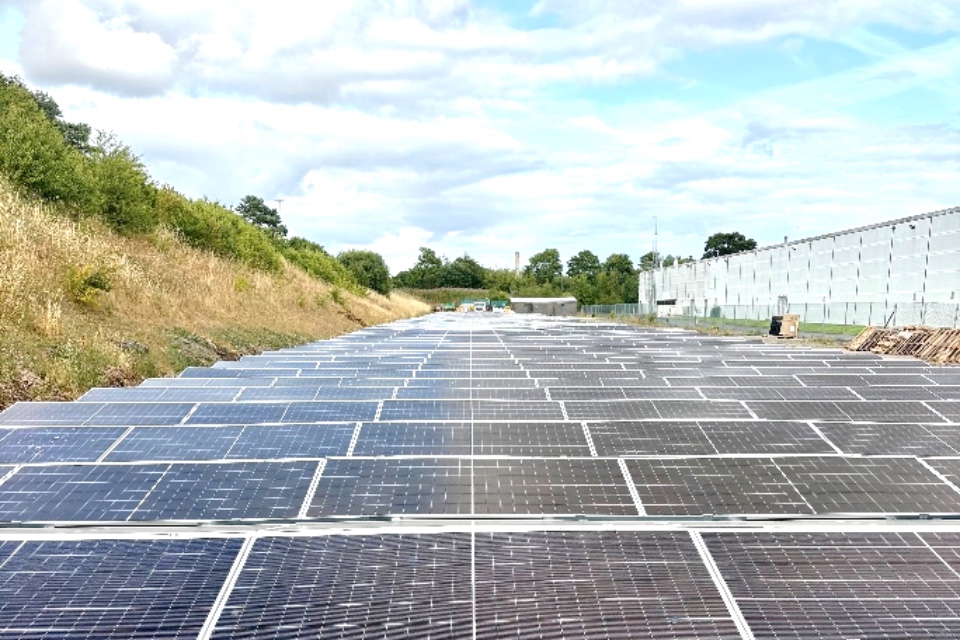
- Ground-mounted solar sites
For many businesses, large roof areas provide valuable space that would otherwise generate no direct return.
The opportunity is particularly attractive where buildings consume significant amounts of electricity during daylight hours.
Commercial Solar PV Systems
A commercial solar installation should be designed around the site rather than selected as an off-the-shelf product.
The process may include:
Energy analysis → site survey → system design → financial modelling → grid application → installation → commissioning → monitoring
Suppliers may provide some or all of these services.
Energy Efficient Solutions Group, for example, delivers commercial solar PV alongside technologies including battery storage, EV charging and other energy-efficiency solutions.
Energy Efficient Solutions Group – https://eesgroup.co.uk/
Two Blues Solar similarly specialises in commercial solar projects, including development, installation and ongoing management.
Two Blues Solar – https://twobluessolar.com/
Buyers should establish exactly which elements of the project a supplier will manage and where third parties will be involved.
Start with Electricity Consumption
Before counting solar panels, understand the site’s electricity profile.
Two organisations consuming exactly the same number of kilowatt-hours annually may have very different solar opportunities.
Business A
High electricity demand from 8am–6pm.
Business B
Most electricity consumed overnight.
Solar generation is naturally concentrated during daylight.
Business A may therefore be able to consume considerably more solar electricity directly onsite.
This matters because electricity used behind the meter can displace electricity that would otherwise have been purchased from the grid.
Solar PV Principle
Don’t start by asking:
“How much solar can we install?”
Start with:
“How much solar electricity can we use effectively?”
The answers may lead to very different system designs.
Analyse Half-Hourly Electricity Data
Annual electricity consumption alone provides an incomplete picture.
Where available, buyers should examine half-hourly consumption data to understand:
- Baseload
- Daytime demand
- Seasonal variation
- Weekend demand
- Operational peaks
This can then be compared with expected solar generation.
The objective is to understand the likely relationship between:
Generation profile ↔ consumption profile
Energy consultants and utilities specialists can help organisations build this picture.
Trident Utilities, for example, provides energy-management, procurement and sustainability services that can help businesses understand consumption, cost and wider energy strategy.
Trident Utilities – https://tridentutilities.co.uk/
Solar should ideally form part of that wider strategy rather than being assessed independently of the organisation’s energy use.
Assessing Site Suitability for Solar PV
Not every roof or site offers the same opportunity.
A feasibility assessment should consider:
- Available area
- Orientation
- Roof pitch
- Shading
- Structural capacity
- Roof condition
- Access
- Existing services
- Fire considerations
- Planning requirements
- Grid connection
For rooftop installations, the expected remaining life of the roof is particularly important.
Installing solar panels onto a roof likely to require replacement shortly afterwards could create substantial additional cost and disruption.
The solar installation and building fabric therefore need to be considered together.
Roof-Mounted vs Ground-Mounted Solar
Commercial solar PV is not restricted to rooftops.
Rooftop solar
Can make productive use of existing building space and locate generation close to electricity demand.
Ground-mounted solar
May be appropriate where organisations have suitable land and require larger generating capacity.
Solar carports
Can combine electricity generation with parking infrastructure and potentially EV charging.
The appropriate approach depends on the estate, planning environment, electricity requirements and commercial objectives.
Some organisations may ultimately use a combination of technologies across a portfolio.
Choosing Commercial Solar Panels
Panel specifications can appear highly technical.
Important considerations include:
- Rated output
- Module efficiency
- Physical dimensions
- Product warranty
- Performance warranty
- Degradation
- Temperature performance
- Manufacturer track record
Higher-efficiency panels can generate more power from a given area, which may be valuable where roof space is constrained.
But efficiency should not be evaluated in isolation.
Buyers need to consider:
Cost + available space + expected generation + warranty + system design
A slightly less efficient module may still produce a stronger commercial outcome depending on the project.
Solar PV Inverters
Panels often receive most of the attention, but the inverter is a critical part of the system.
It converts the DC electricity generated by the panels into AC electricity.
Buyers should consider:
- Inverter efficiency
- System architecture
- Manufacturer
- Warranty
- Monitoring
- Expected lifespan
- Replacement cost
Different designs may use:
- Central inverters
- String inverters
- Microinverters
The most appropriate architecture depends on factors including system size, layout and shading.
Ask the installer to explain why the proposed inverter configuration is appropriate rather than accepting equipment selection purely as a technical detail.
Understanding Solar PV Yield
A supplier should provide an estimate of expected annual electricity generation.
But buyers need to understand the assumptions behind that number.
Solar yield can be influenced by:
- Geographic location
- Orientation
- Panel angle
- Shading
- Module performance
- Temperature
- System losses
- Inverter efficiency
Forecasts should be realistic rather than simply based on maximum panel output.
Buyers should ask to see expected generation across the year rather than only one annual figure.
That can then be compared with seasonal electricity demand.
Self-Consumption vs Export
Solar electricity generally has two destinations.
Use it onsite
or
export it to the grid.
For many commercial projects, maximising useful onsite consumption is central to the financial case.
Imagine a system generating 500,000 kWh annually.
Organisation A consumes 450,000 kWh directly.
Organisation B consumes 200,000 kWh and exports the remainder.
Both have identical generation, but their economics may be significantly different depending on avoided electricity costs and export arrangements.
Energy Insight
Solar generation is not the same thing as solar value.
The business case depends on what happens to each kilowatt-hour after it is generated.
Grid Connection for Commercial Solar
Grid connection can become an important project constraint, particularly for larger systems.
The relevant Distribution Network Operator may need to assess the proposed installation and determine how much generation can be connected or exported.
Potential issues include:
- Network capacity
- Export limitations
- Connection costs
- Application timescales
Buyers should establish early who is responsible for:
- Grid applications
- Technical documentation
- Liaison with the network operator
- Export limitation requirements
A project should not progress on the assumption that unlimited export capacity will automatically be available.
Solar PV and Battery Storage
Battery storage can change how an organisation uses solar generation.
Instead of immediately exporting surplus electricity, a battery can potentially store it for later use.
For example:
Midday: solar generation exceeds building demand → battery charges
Evening: solar generation falls → battery discharges
This can increase solar self-consumption.
But that does not mean every solar installation requires a battery.
The business case depends on:
- Generation profile
- Consumption profile
- Electricity tariffs
- Export value
- Battery cost
- Battery cycling
- Wider flexibility opportunities
Wattstor specialises in energy-management and battery-storage technology designed to optimise distributed energy resources including solar PV.
Wattstor – https://wattstor.com/
Its approach illustrates an important development in onsite energy: solar, storage and electricity demand can increasingly be managed as an integrated system rather than as separate assets.
Solar PV, Batteries and Energy Management Systems
As sites become more complex, an energy management system can determine when different assets should operate.
A site might have:
- Solar PV
- Battery storage
- EV chargers
- Flexible loads
- Grid electricity
Software can potentially optimise when to:
- Consume solar
- Charge the battery
- Discharge stored electricity
- Import from the grid
- Export electricity
The objective may vary according to:
- Energy cost
- Carbon
- Peak demand
- Grid constraints
- Operational requirements
This is one reason solar procurement should consider the organisation’s future energy strategy, not simply today’s electricity consumption.
Financing Commercial Solar PV
Organisations do not necessarily have to purchase solar PV outright.
Potential models include:
Capital purchase
The organisation funds and owns the system.
This requires upfront capital but may provide the greatest long-term benefit if the project performs as expected.
Power Purchase Agreement
A third party may fund and own the solar system while the organisation purchases the electricity generated under a long-term agreement.
Lease or financed solution
Other commercial structures can spread project costs over time.
Energy providers such as DCC Energy operate across commercial energy and energy-transition services, reflecting the increasingly broad range of approaches available to organisations seeking to decarbonise energy use.
DCC Energy – https://www.dccenergy.com/
Buyers should compare the lifetime economics rather than focusing only on whether a project requires upfront capital.
Comparing Solar PV Payback
Simple payback is frequently used to evaluate solar projects.
For example:
Project cost ÷ annual financial benefit = simple payback
But this can hide important assumptions.
A financial model may need to consider:
- Electricity-price assumptions
- Export revenue
- Generation degradation
- Maintenance
- Inverter replacement
- Finance cost
- Tax treatment
- Project lifespan
Buyers should ask suppliers to show clearly which assumptions drive the projected return.
Sensitivity analysis can also help.
What happens if electricity prices are lower than forecast?
What happens if self-consumption is lower?
A robust project should not depend on unrealistically optimistic assumptions.
Commercial Solar PV Warranties
Solar projects commonly involve several different warranties.
These may include:
- Panel product warranty
- Panel performance warranty
- Inverter warranty
- Mounting-system warranty
- Installation workmanship warranty
These are not interchangeable.
A module performance warranty, for example, may specify how much generating capacity the panel is expected to retain after a particular period.
Buyers should understand:
- Who provides each warranty
- What it covers
- How claims are made
- What happens if the installer no longer operates
Long warranty periods are valuable only when the terms and responsible organisations are credible.
Solar PV Monitoring
Once installed, solar should not become invisible simply because it has few moving parts.
Monitoring can identify:
- Generation
- Inverter performance
- System faults
- Underperforming strings
- Export
- Self-consumption
A significant fall in generation may otherwise remain unnoticed.
Commercial energy services providers increasingly combine solar with monitoring and broader energy optimisation.
Egg, for example, provides commercial renewable-energy solutions spanning technologies including solar PV, battery storage and EV charging.
Egg – https://www.egg.com/
Buyers should establish who monitors the system after installation and who is responsible for acting when performance falls below expectations.
Operations and Maintenance
Solar PV is relatively low maintenance, but low maintenance does not mean no maintenance.
Requirements may include:
- Visual inspection
- Electrical testing
- Inverter maintenance
- Performance monitoring
- Vegetation management for ground-mounted systems
- Cleaning where necessary
The appropriate maintenance regime will depend on the system and environment.
Buyers should understand:
- Recommended inspection frequency
- Maintenance cost
- Response times
- Remote monitoring
- Fault resolution
- Replacement parts
Operations and maintenance should be considered within the original financial model.
Temporary and Off-Grid Solar
Not every commercial solar application involves permanently mounting panels onto a building.
Temporary works, construction sites, events and remote operations may use solar technologies to reduce reliance on diesel-powered equipment.
Prolectric Services specialises in off-grid renewable technologies including solar lighting, solar hybrid generators and related temporary-power solutions.
Prolectric – https://prolectric.co.uk/
This demonstrates the breadth of commercial solar applications.
For energy managers overseeing diverse estates or temporary operations, the question may not simply be where permanent PV can be installed, but where solar can replace or reduce existing fuel consumption.
Solar PV and Carbon Reduction
Solar PV can support organisational decarbonisation by reducing reliance on grid electricity.
But buyers should distinguish between:
- Electricity generated
- Financial savings
- Carbon reduction
These are related but different metrics.
Organisations reporting emissions reductions should ensure they use appropriate carbon-accounting methodologies and current emissions factors.
The UK Government publishes greenhouse-gas conversion factors for organisational reporting.
UK Government – Greenhouse Gas Reporting: Conversion Factors – https://www.gov.uk/government/collections/government-conversion-factors-for-company-reporting
Solar investment should therefore connect with the organisation’s wider energy and carbon strategy.
Planning for Future Energy Demand
Today’s electricity profile may not be tomorrow’s.
Future changes could include:
- Electric vehicles
- Heat pumps
- Electrified processes
- Building expansion
- Increased cooling
- New production equipment
These can significantly increase electricity demand.
A solar installation designed solely around current consumption may therefore miss future requirements.
Conversely, a business expecting to leave a site or significantly reduce operations should avoid basing investment on demand that may disappear.
Buyers should consider expected changes over the lifetime of the installation.
Choosing a Commercial Solar PV Supplier
Commercial solar projects require a mixture of capabilities.
These may include:
- Energy analysis
- Site surveying
- Structural assessment
- Electrical design
- Solar design
- Grid applications
- Installation
- Commissioning
- Monitoring
- Maintenance
Some providers deliver the complete project.
Others specialise in individual stages or combine solar with wider energy consultancy and optimisation.
The right model depends on how much expertise the organisation retains internally.
What Should Buyers Compare?
Site assessment
How thoroughly will roof, structure, shading and electrical infrastructure be evaluated?
Energy analysis
Will system design reflect actual consumption data?
Equipment
Which panels, inverters and mounting systems are proposed?
Yield
How has expected generation been calculated?
Self-consumption
How much generated electricity is expected to be used onsite?
Grid
Who manages the grid-connection process?
Finance
What ownership and funding models are available?
Storage
Has battery integration been evaluated appropriately?
Monitoring
How will system performance be tracked?
Maintenance
What happens after commissioning?
Questions to Ask Commercial Solar PV Suppliers
- How will you analyse our electricity consumption?
- Will you use half-hourly consumption data?
- How much of our electricity demand could solar supply?
- What proportion of generation do you expect us to consume onsite?
- How has the proposed system size been determined?
- What site and structural surveys are required?
- Which solar panels are proposed and why?
- Which inverter technology will be used?
- What annual generation do you forecast?
- Which assumptions underpin that forecast?
- Who will manage the grid-connection application?
- Are any export restrictions expected?
- Should battery storage form part of the project?
- What financing options are available?
- What simple payback and lifetime return are forecast?
- How sensitive is the business case to electricity prices?
- Which warranties apply?
- How will system performance be monitored?
- What maintenance is required?
- What support is available if the system underperforms?
Frequently Asked Questions
What is commercial solar PV?
Commercial solar PV uses photovoltaic panels to generate electricity for businesses and other organisations, commonly through rooftop or ground-mounted systems.
How does solar PV work?
Solar panels generate DC electricity from sunlight. An inverter converts it into AC electricity that can be used within the building or exported to the electricity network.
Is commercial solar PV worth it?
This depends on installation cost, expected generation, electricity prices, onsite consumption, export value, financing and the anticipated operating life of the system.
Does solar PV work in the UK?
Yes. Solar PV generates electricity from daylight rather than requiring hot weather, although generation varies significantly by season and weather conditions.
Do commercial solar panels need battery storage?
Not necessarily. Battery storage may improve the economics of some sites by allowing surplus solar electricity to be used later, but its value depends on the site’s generation, consumption and tariff profile.
How long do commercial solar panels last?
Solar modules are designed as long-life assets and manufacturers commonly provide long performance warranties, although buyers should examine individual product specifications, degradation assumptions and wider system-component lifetimes.
Do solar PV systems need maintenance?
Yes. Although maintenance requirements can be relatively modest, installations require appropriate monitoring, inspection and electrical maintenance to ensure safe and effective operation.
Product Guide
Commercial solar PV involves much more than panels alone. Suppliers across the market provide system design and installation, energy consultancy, financing, battery storage, optimisation and specialist off-grid solar technologies. TYou can meet all the companies below at the Energy Management Summit.
Featured Suppliers
DCC Energy
International energy business supporting commercial and domestic customers across conventional and lower-carbon energy. Its energy-transition activities encompass renewable and energy-management solutions that can help organisations develop broader strategies around onsite generation, electrification and decarbonisation.
Website: https://www.dccenergy.com/
Egg
Clean-energy technology provider offering commercial solutions including solar PV, battery storage and EV charging. Its services support businesses seeking to generate renewable electricity onsite and integrate solar with wider electrification and energy-management requirements.
Website: https://www.egg.com/
Energy Efficient Solutions Group
UK energy-efficiency and renewable-technology provider delivering commercial solar PV alongside battery storage, EV charging and other energy solutions. It supports organisations from project assessment and design through installation and ongoing energy optimisation.
Website: https://eesgroup.co.uk/
Prolectric Services
Specialist in off-grid renewable technology providing solar lighting, solar hybrid generators and related solutions for construction, infrastructure and commercial applications. Its technology can help organisations replace or reduce diesel-powered temporary equipment using solar energy.
Website: https://prolectric.co.uk/
Trident Utilities
UK energy-management and procurement specialist helping organisations understand and manage energy consumption, cost and carbon. Its services span energy procurement, data and metering, sustainability and energy-management consultancy, providing wider strategic context for renewable-energy investments.
Website: https://tridentutilities.co.uk/
Two Blues Solar
Commercial solar specialist developing and delivering solar PV projects for organisations seeking to reduce energy costs and carbon emissions. Its capabilities span commercial project development, installation and management of solar assets.
Website: https://twobluessolar.com/
Wattstor Ltd
Energy-management technology specialist combining battery storage with intelligent software to optimise distributed energy assets including solar PV. Its platform can coordinate generation, storage, consumption and grid interaction to help organisations increase the value of onsite renewable energy.
Website: https://wattstor.com/
Explore Commercial Solar PV Solutions
Commercial solar PV has a relatively simple fundamental proposition: generate electricity where it will be used.
Creating the strongest business case, however, requires a much more detailed understanding of when the organisation consumes electricity, how much solar the site can realistically generate and what happens to that electricity once it has been produced.
That makes energy data the starting point for good solar procurement.
The strongest projects combine suitable sites, realistic generation forecasts, high levels of useful onsite consumption, appropriate equipment and effective long-term monitoring.
And as businesses increasingly adopt battery storage, EV charging and electrified heating, solar PV can become one component within a much more integrated onsite energy system.
The Energy Management Summit connects senior energy and sustainability professionals with carefully selected providers of solar PV, energy storage, energy management and associated services through a programme of pre-arranged one-to-one meetings.
Explore commercial solar PV solutions, compare specialist providers and discover technologies and services that can help organisations reduce electricity costs, generate more renewable energy onsite and progress towards long-term decarbonisation goals.
Image credit: https://unsplash.com/photos/a-man-in-a-hardhat-working-on-a-solar-panel-JlhvFEVMwng